On the standard table of height on which many mountains claim top spots, Rainier is not to be seen. It stands at a mere 14,410 feet, and in comparison with Everest’s 29,032 feet, nothing too special it would seem. Yet, on one fine and clear day on the I-5, when Rainier suddenly loomed at the end of the freeway, the first time I saw this mountain, she looked taller and mightier than all before her. I gasped for breath in my car not knowing how to process this image of a behemoth roaring so tall and seemingly loud, sticking her head into matters not known to us mortals. It slowly dawned on me, this was what everyone was talking about after I moved to Seattle. “Oh have you seen Rainier yet?”, “Wait till you see it!”, “You will see it, the clouds can’t cover it all the time, eventually it will reveal itself to you!”. And now she had indeed revealed herself to me and what a grand sight it was to see Rainier shining like a mystical empress seeing off into the horizon of battle, her hair flying in the wind. Victorious, yet magnanimous.
Sunrise on Rainier as seen from the Fremont fire lookout
The 2023 attempt: The one that never began
In 2023, I registered myself for the 4-day Rainier Summit Climb offered by RMI Expeditions. The climb was scheduled to start late in August but was unfortunately called off by RMI one week prior to the start of the expedition. The reason was due to the unusually hot 2023 summer which made things very unstable on top of the mountain. On top of this, towards the end of August, Washington witnessed a severe heat wave that rapidly destabilized the standard routes over the glaciers making it very dangerous for climbers looking to make a bid for the summit. This was sad news for me and it meant that I would have to wait for the next climbing season to try again. I was desperate to climb Rainier, and in my desperation I had likely underestimated the challenge of Rainier. I would learn about it soon enough when I bid for the summit once again in 2024. So this misfortune with the heat wave might have been for a valid reason. All in good time, as they say!
The view of Rainier from Olympic Sculpture Park where I trained for the climb everyday
I would often hear stories of unlucky folks who have been unsuccessfully trying to summit Rainier for years and years. Driving down I-5, I would stare at Rainier and wonder if I would ever get a chance to stand on its top. On any given day, the chance of summiting Rainier is 50/50, even on the best day! A lot of factors compete to ruin your chances, volcanic activity, temperature variations, wind conditions, avalanche activity, snow conditions, seismic activity, and so on. It is a complex set of variables all in all working against you to not let you touch that sweet summit.
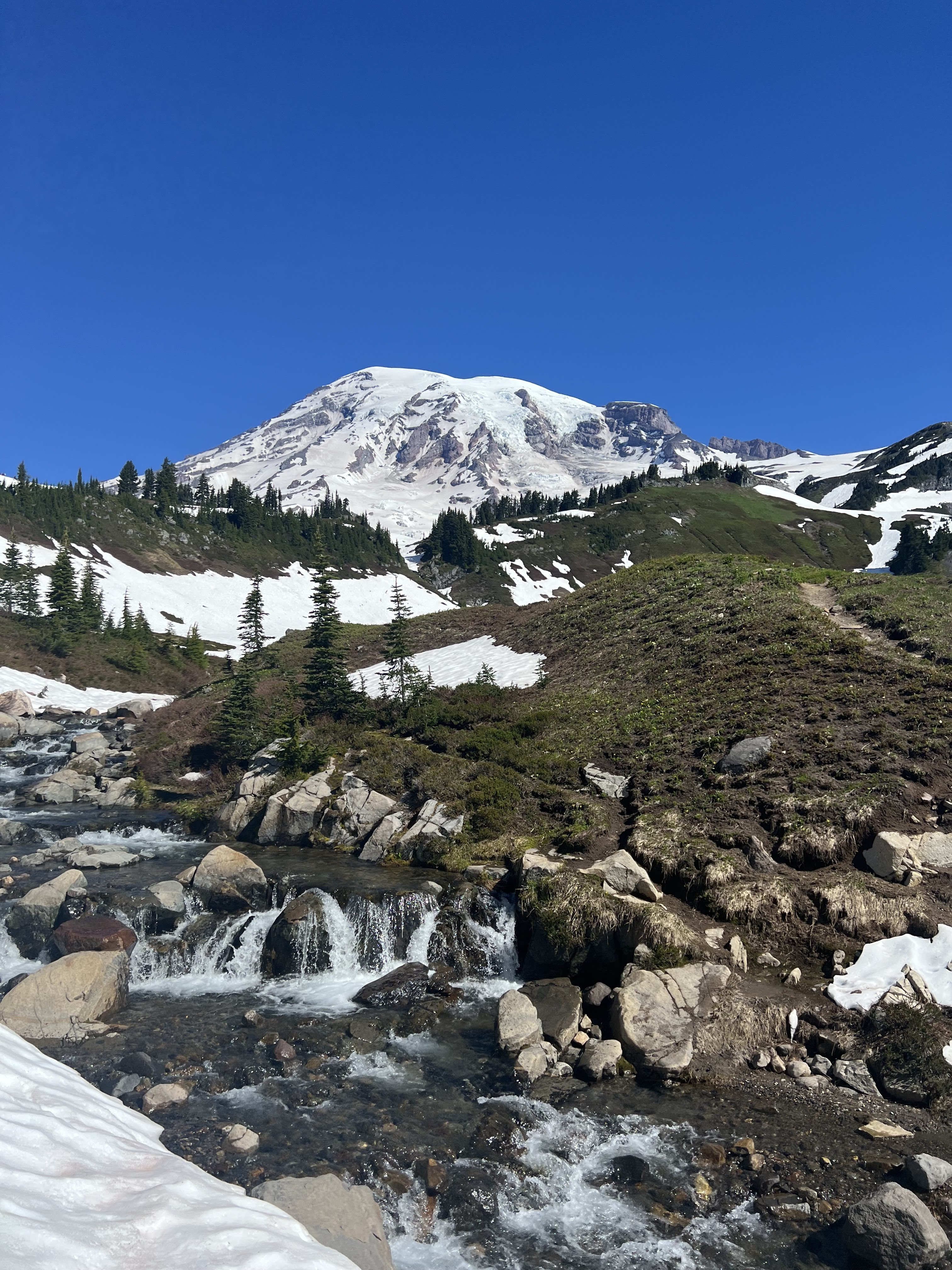
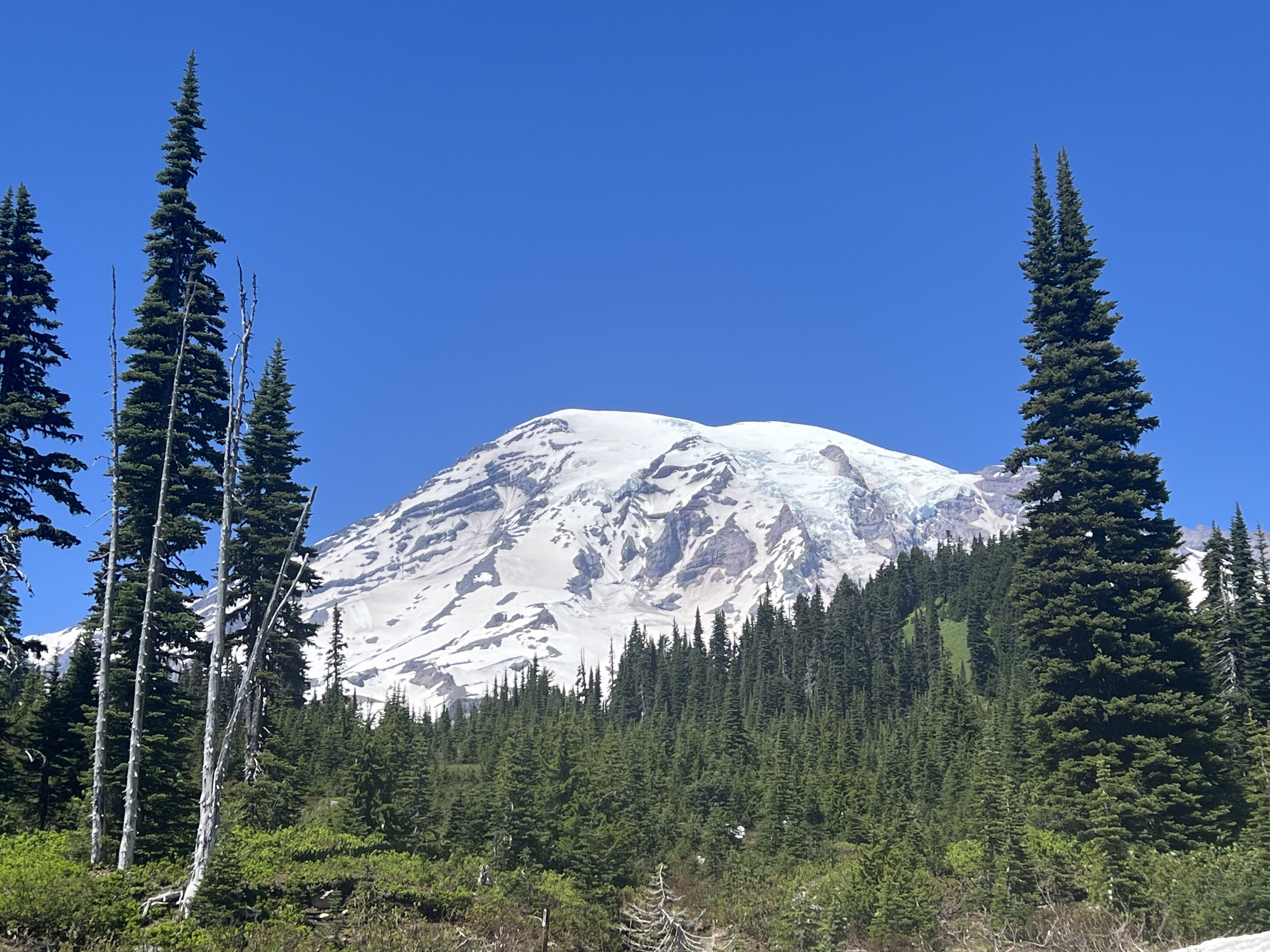
Rainier as seen from Myrtle Falls near the Paradise Visitor Center
The 2024 attempt: The one that somehow worked out
In 2024, I registered once again for the 4-day Rainier Summit Climb offered by RMI Expeditions. The cost of the 4-day program was roughly $2000. Equipment costs was an additional lump of expenses. Though mountaineering is a very expensive hobby, the expenses are usually well justified as the purpose of it is to keep you alive and that is priceless 🙂
Now is a good time to mention about RMI Guides and why I chose to go with them. Well here is the reason, RMI is short for Rainier Mountaineering, Inc. It is by far the most well established and popular guided mountaineering service on Rainier. Their history is deep, starting with their legendary co-founder Lou Whittaker who in 1984, led the first successful American summit of the North Col of Mount Everest. Lou has climbed Rainier over 250 times beginning first at the age of 16. He started RMI to establish a guide service dedicated to teaching and leading climbers. The Whittaker climbing network is well established and RMI usually gets the best guides. Their obsession on safety is what convinced me to pick them for my summit attempt.
Day 1 – Getting to know the team and gear check
The first day was all about getting to know the team, and the guides. We were to assemble in the Rainier BaseCamp in Ashford, WA. Ashford is a small mountain community that serves as the gateway to the Nisqually Entrance to Mt. Rainier National Park. It is a quiet community tucked away in the forested foothills of Rainier. An advantage of picking RMI service is that everything needed for the expedition is right there in one complex: The Rainier BaseCamp in Ashford has a mountain equipment store, a mountain rental store, a bar & grill, and lodging! Plus, the expedition buses leave from this complex. So, I booked my lodging for the first night at the historic Whittaker’s bunkhouse. The bunkhouse was cost friendly, and neat. Additionally, everything I might possibly need was a stone’s throw away.
On Day 1, I met the team and we introduced ourselves. There were a total of 9 people in Team A, and 9 people in Team B. Each Team had one main guide and two support guides. I was in Team A. Our team was led by Lacie Smith, with the other two guides, Drew Obrien and George Hedreen. It was evident from what they spoke, and the way they spoke it, that they were seasoned students of the Great Outdoors. Drew, for instance, has climbed Rainier over 50 times and has summited Denali, the highest mountain in North America. Lacie, a mountaineer, and rock climber pursuing a nursing degree on the outside. George, an ice climber and a ski mountaineer. The three of them together formed a formidable team of guides and I had full faith in their leadership.
After introductions we spent two hours for Gear-check. This was a detailed personal equipment discussion and gear check, an introduction to safety practices, including the use of helmets, harnesses, and avalanche transceivers, and instruction regarding Leave No Trace practices and environmental considerations. We are also briefed on what to expect from the mountaineering day school on the next day.
Day 2 – Mountaineering day school on the slopes of Rainier
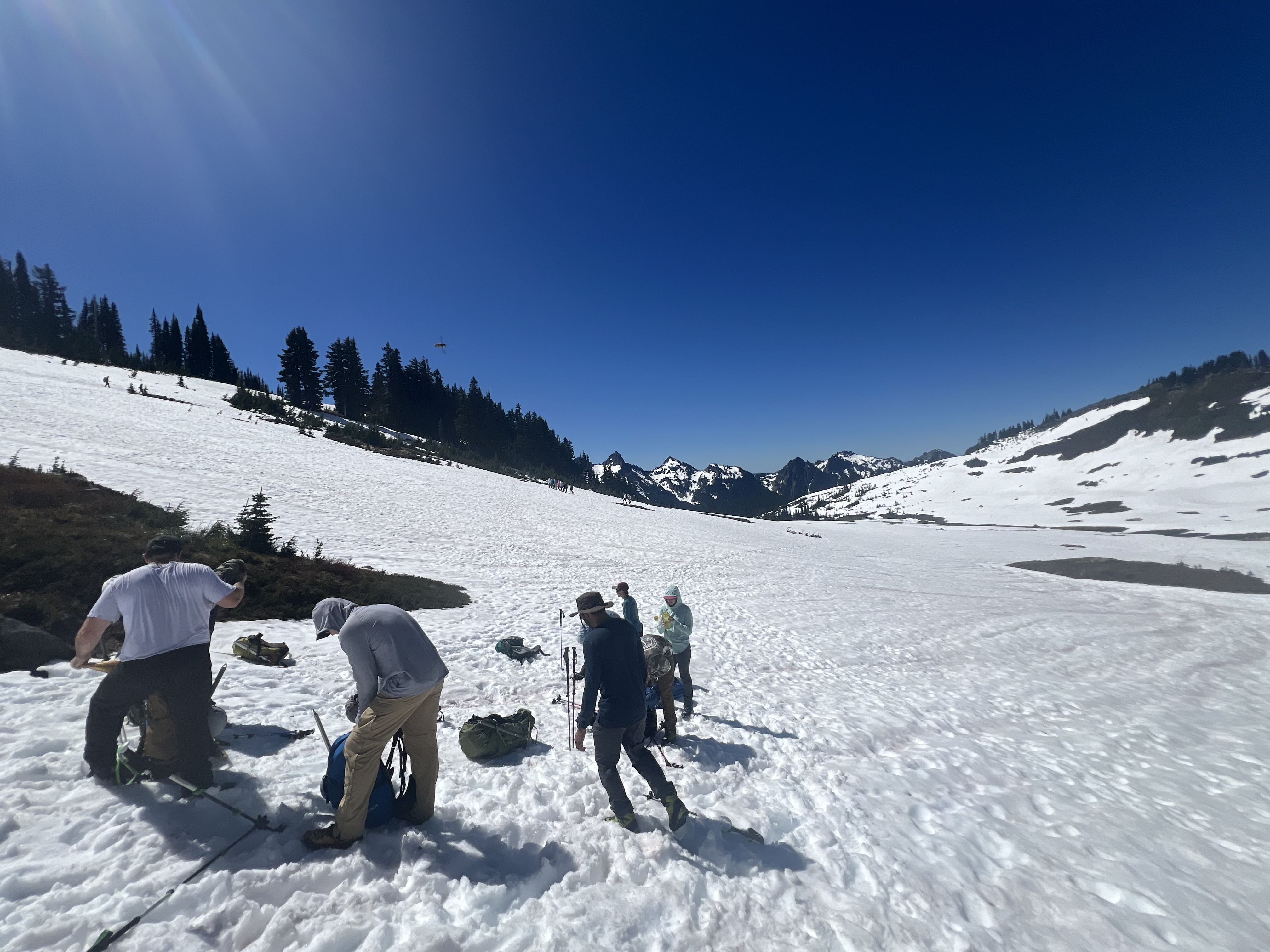
On Day 2, we left BaseCamp at 8:30AM for the hour long drive from Ashford to Paradise. From Paradise we hiked for about an hour to reach the slope where we would be learning the basics of mountaineering.
One of the first techniques we learned was self-arresting, a skill that involves using an ice axe to stop a fall on a steep slope. Mastering this skill was crucial, as a well-executed self-arrest could prevent a dangerous slide down icy terrain. The guides drilled us on proper positioning, emphasizing quick reactions and teaching us to dig the axe into the snow with our body weight to halt momentum in case of a slip. Learning this gave us a newfound confidence, knowing we had a tool and technique to regain control if conditions turned treacherous.
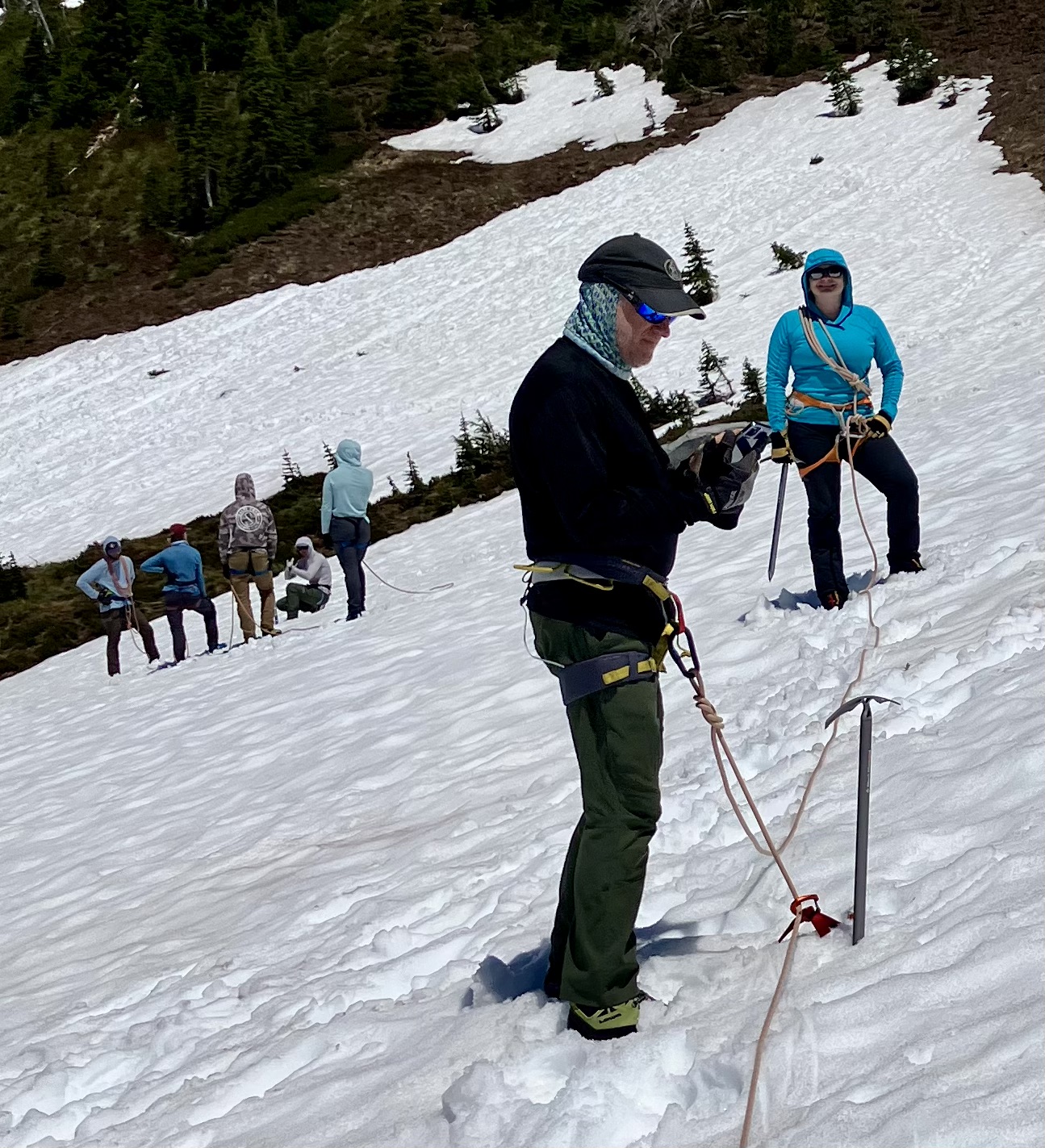
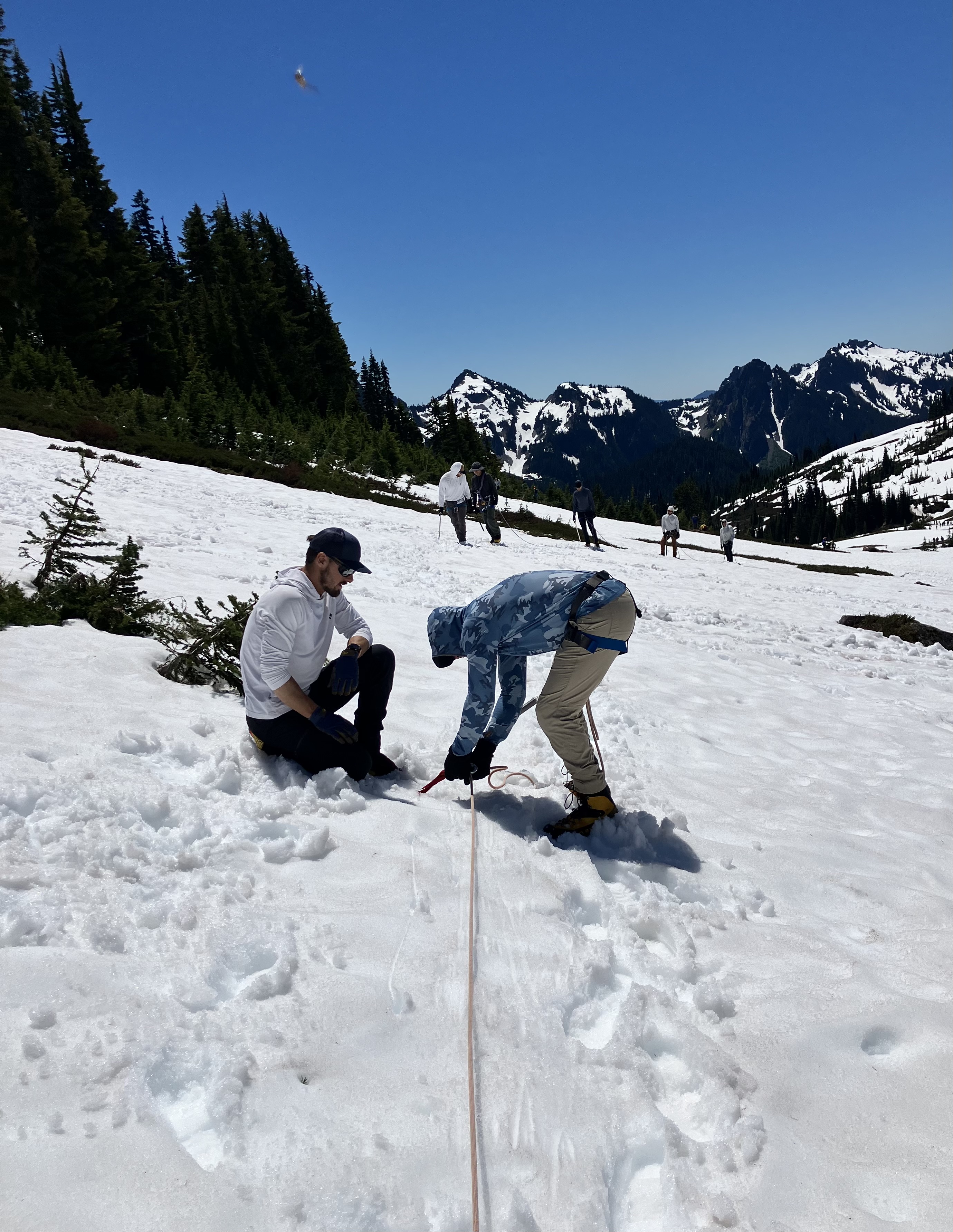
We also practiced roped travel, which is essential for crossing glaciers safely. As a team, we learned how to move in unison, keeping the rope evenly tensioned to maintain a safe but flexible distance between climbers. This technique is particularly important in crevasse-ridden areas, as roped travel allows team members to arrest a fall if someone unexpectedly breaks through the snow into a hidden crevasse. Our guides also taught us the rest step — a slow, deliberate technique that conserves energy on steep ascents by allowing each leg to briefly relax in between steps. Additionally, we went over basic avalanche rescue techniques, learning how to use an avalanche beacon, probe, and shovel to locate and assist buried climbers.
By the time we were done at 3PM, I had understood the importance of these techniques for safe passage on the mountains. These are fundamental to a mountaineer.
Taking a break during the Mountaineering day schoolLearning self-arresting techniqueBasics of roped travel Practicing belaying Learning about harnesses and the basics of roped travel
Day 3 – To Camp Muir
The day had finally arrived. The actual climb starts on Day 3. We arrived at Paradise Inn at 9:30 AM and began our slow ascent to Camp Muir. Our backpacks were at their heaviest on Day 3 as we were carrying the full gear to Muir, from where we would launch our summit bid late that night.
The climb from Paradise to Camp Muir is a challenging trek, often considered one of the first big tests for climbers aiming to summit Mount Rainier. Starting at an elevation of 5,400 feet, the journey covers roughly 4.5 miles with an ascent of nearly 4,600 feet. The trail begins on a well-defined path through scenic alpine meadows filled with wildflowers in the summer and transitions into snowfields and rocky slopes as you gain altitude.
The steady climb to Camp MuirMy fellow team members looking stoic and determined
The snow is a giant mirror that is reflecting the sun’s energy onto your body. Without proper precaution climbers risk having their skin burnt, and eyes go blind. Glacier sunglasses is a necessity and protects the retina. Sun hoodies, and sunscreen protects the body and reduces the exposure to the UV radiation.
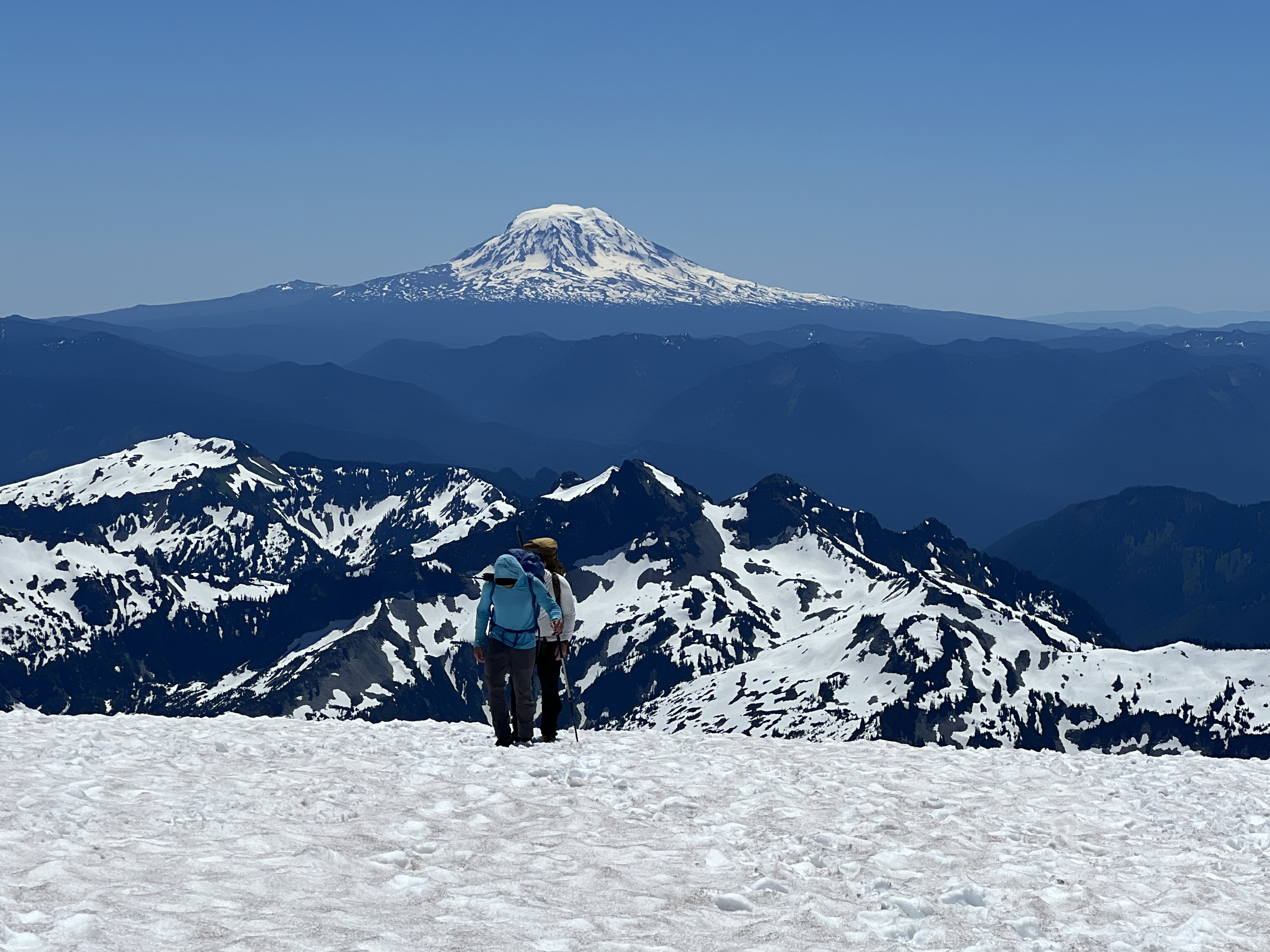
Mount Adams looms in the background as we slowly make our way to Camp MuirA lone climber
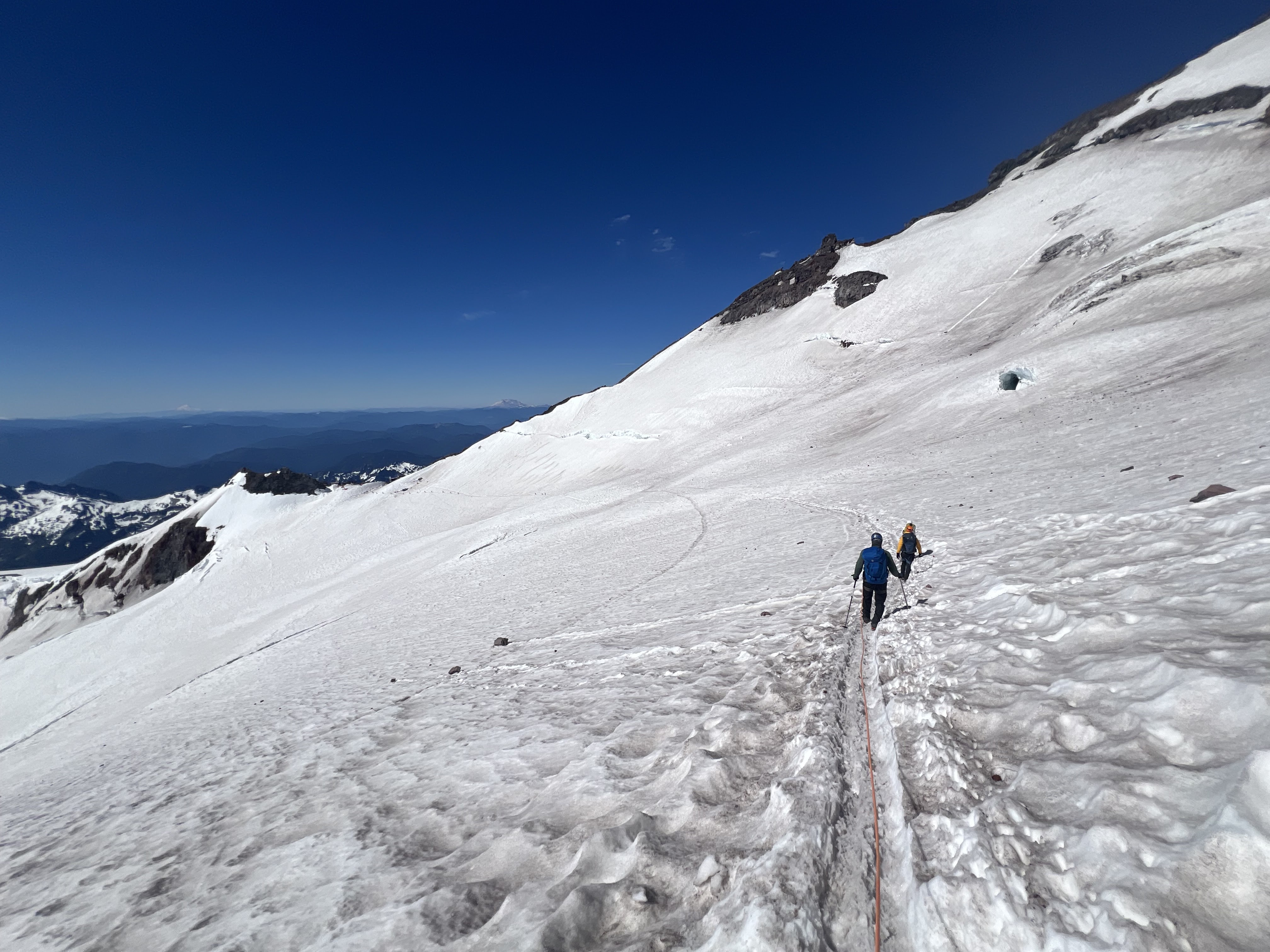
As you approach the Muir Snowfield, conditions become more demanding, with loose scree, snow, and potential whiteout weather posing significant hurdles. Although physically taxing, this section of the climb is spectacular, offering views of the Nisqually Glacier, Mount Adams, and even Mount St. Helens on clear days. The Muir Snowfield’s consistent, steep incline requires careful pacing and focus, especially with the added weight of summit packs. Reaching Camp Muir after hours of ascent feels like a significant accomplishment, providing climbers with a first taste of high-altitude conditions and the camaraderie of mountaineers gathering for the night.
Left: Mount Adams, Far off in the Right: Mount JeffersonThe scene around us as we climb to Camp Muir
Camp Muir
Camp Muir is a waypoint on the journey to the summit of Mount Rainier, providing both a mental and physical transition from the initial approach to the high alpine ascent. Located at 10,060 feet, this camp is a stop where climbers can rest, acclimate, and prepare for the challenges that lie ahead. Named after naturalist John Muir, who climbed Rainier in 1888, Camp Muir holds historical significance as a longstanding base for mountaineers. The camp offers breathtaking views of the surrounding glaciers and volcanic landscape, serving as both a humbling and exhilarating reminder of the mountain’s rugged beauty. For many, reaching Camp Muir marks a major milestone, symbolizing not only physical endurance but also commitment to the climb. Here, climbers adjust to thinner air, finalize gear checks, and receive last-minute briefings, making it a critical staging point before the summit push on Rainier’s unpredictable slopes.
Camp Muir. On the left is RMI’s Mountain Hut. On the right is the Ranger Station and the Guide hut. In the rear, the toilets. Gas cylinders and weather equipment on Camp MuirInside the RMI Mountain Hut
The sunset from Camp Muir was intense.
Mount St. Helens from the blown off side of the mountain from the volcanic eruption of 1980
Summit Talk
Day 2, 6:30 PM, inside RMI’s Mountain Hut
The summit talk on the night before our summit bid was an intense, grounding experience. Our guides gathered us in a huddle inside the cozy mountain hut, our faces grim, attentive against the encroaching darkness. The air was electric with anticipation, as they laid out the plan. They described the route we’d be taking, highlighting critical sections like the Cowlitz Glacier and Disappointment Cleaver, emphasizing how conditions would require vigilance and precision at every step. Their tone was calm but firm, underscoring the respect we needed for the mountain and each other.
All hands on deck for the summit talk led by Lacey Smith
The guides reminded us to check our gear meticulously, stressing that small details — the fit of our harness, the quality of our knots — could make all the difference in moments of crisis. They talked about the importance of self-awareness and communication, encouraging us to speak up if we felt even a hint of altitude sickness, weakness, or discomfort. “Safety first, summit second,” they said. “This is your climb, but we do it as a team.”
The guides addressed the wind conditions, which were less than ideal. They were straightforward about the reality that, despite our preparation and determination, the mountain might not grant us the summit. They explained that if the winds picked up further, Ingraham Flats — the high camp at around 11,000 feet — might be the farthest we could safely climb before needing to turn back.
They reminded us that success on a mountain like Rainier isn’t just about reaching the summit; it’s also about respecting the conditions and making wise, sometimes humbling decisions. Safety would always come first, and our goal was to return safely, whether we reached the summit or not. Hearing this was sobering, but it also highlighted the seriousness and respect that the mountain demands. The guides reassured us, though, that Ingraham Flats itself was a significant milestone — and reaching it would still be an accomplishment to be proud of. They encouraged us to prepare for the journey as if we were going for the summit, keeping spirits high, but to also accept that sometimes, the mountain has the final say.
Then, the guides spoke about the beauty and the reward of the summit, painting a vivid picture of what awaited us as dawn broke. Their words were an inspiration and a reminder of the reason we were all here — to test ourselves and reach the top, if the mountain allowed. By the end of the talk, we felt united, exhilarated, and grounded in the reality of the climb ahead.
Our guides kept the timing of the summit bid deliberately vague, adding to the anticipation and tension of the night. They told us to rest as best we could, even as the excitement kept us on edge, not knowing when we’d be called to climb. The only sign we’d have that it was time to prepare was the arrival of a big flask of hot water. At some unknown hour, they’d bring it to our mountain hut — a signal that we had one hour to get ready, gear up, and make any final checks before setting off. The idea was simple but effective: that steaming flask would be the quiet, unmistakable announcement that the summit attempt was on. It heightened our senses, and many of us lay listening through the night, waiting for the faint sounds of footsteps or murmurs that would tell us the moment was near.
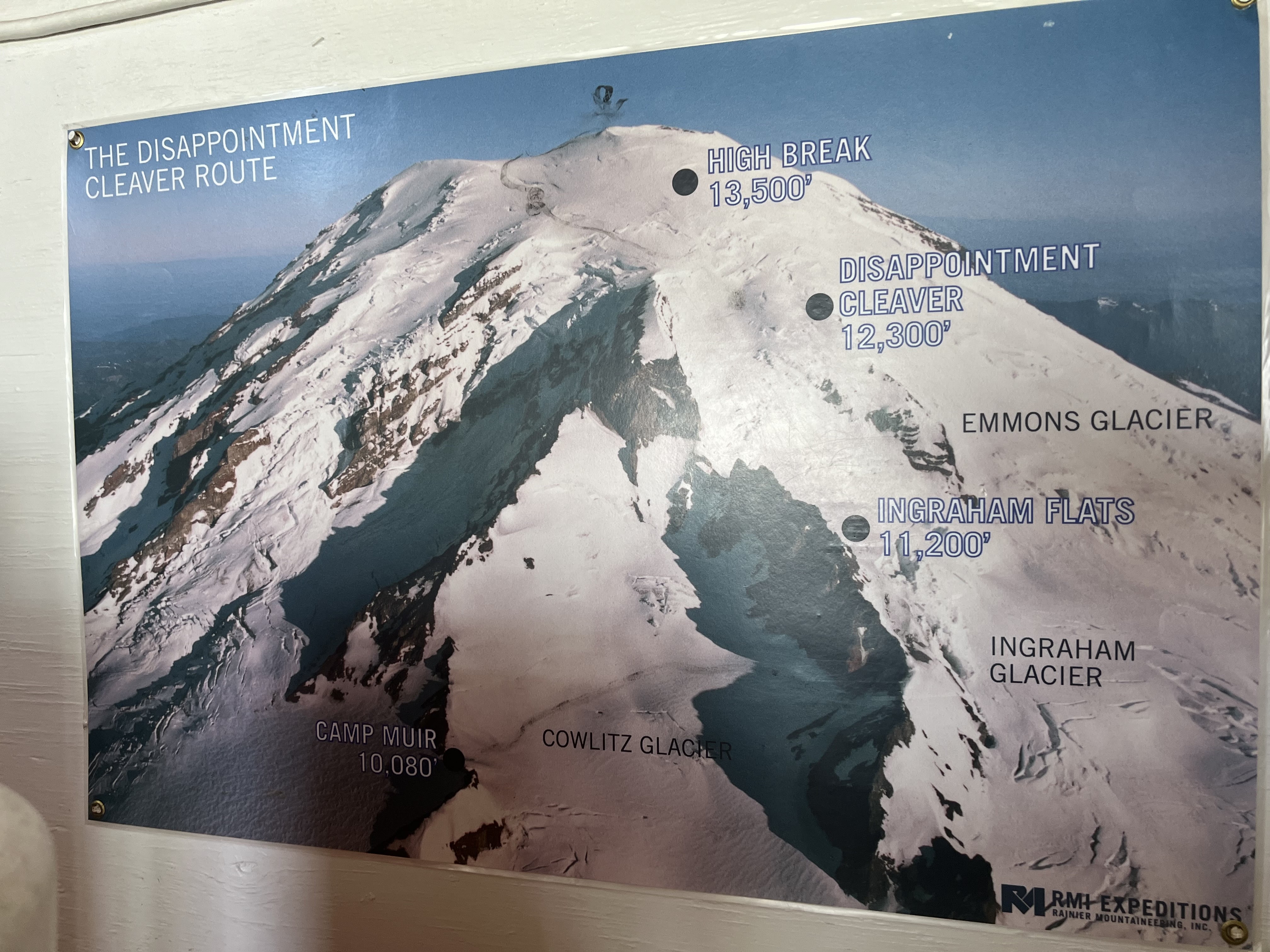
The DC Route to the summit
The Route: Disappointment Cleaver (DC) Route
During the Summit Talk, the guides meticulously explained the route we would be taking to the summit. They spoke about the current conditions and areas of high hazard.
The Disappointment Cleaver (DC) route to the summit of Mount Rainier is one of the most popular and well-traveled paths, but it demands both skill and resilience. Starting from Camp Muir at 10,060 feet, the route ascends a steep, winding path that traverses rock, snowfields, and glaciers over 4,400 vertical feet to reach the 14,411-foot summit. Known for its physically and technically challenging sections, the DC route also comes with significant risks from crevasses, rockfall, and changing weather conditions.
One of the initial tests on the DC route is the crossing of the Cowlitz Glacier, often riddled with snow bridges that conceal crevasses beneath. Following this, climbers cross Cathedral Gap, a steep, loose-rock section notorious for rockfall, especially later in the day when the sun softens ice binding the rocks. Beyond this lies the climb up Disappointment Cleaver itself, a rugged ridgeline that requires precise footwork on loose rock and exposed terrain, where a slip could result in a long fall.
Past the Cleaver, the ascent becomes even steeper, and climbers face traverses across heavily crevassed fields, with routes often changing throughout the season as snow bridges collapse. Weather is another constant challenge; sudden storms and fierce winds are common, creating low visibility and extreme cold. The high altitude and rapidly changing conditions can trigger altitude sickness and hypothermia. The DC route’s combination of exposure, technical challenges, and unpredictable mountain hazards make it both exhilarating and perilous, demanding careful preparation and respect for the mountain’s power.
Day 4 – The summit and back
Climbing the Disappointment Cleaver (DC) route at night amplifies its already considerable dangers, requiring climbers to navigate technical, exposed terrain with limited visibility. The route begins with glacier crossings that conceal hidden crevasses, making each step a potential hazard as climbers rely heavily on headlamp beams to assess their surroundings. Rockfall is a serious risk, particularly in narrow sections like Cathedral Gap, where even slight movements from higher up can dislodge rocks onto those below. Ascending the Cleaver itself involves traversing loose, shifting rock on steep slopes, where darkness intensifies the sense of exposure, and missteps can have severe consequences. Climbers must also monitor the shifting snow bridges and crevasse patterns in the upper sections, where conditions can change quickly with the freezing night air. Compounding these dangers, altitude and cold weather at night can cloud judgment and delay reaction times, making focus and teamwork critical for a safe climb.
Last minute preparations in progress for the summit bid at 11PM
On the DC route, we traveled in rope teams of four, a setup designed to enhance both safety and cohesion. Each team connected climbers at regular intervals with a durable climbing rope, creating a bond of mutual reliance and responsibility. The lead climber set the pace, navigating through crevasses, icy slopes, and rocky terrain, while the others mirrored each step, maintaining tension on the rope to prevent any sudden slack or pull. In case of a fall or a slip, the rope team acts as a built-in safeguard, with each member poised to brace and arrest the fall of another.
These teams required tight coordination and constant awareness of one another’s movements, especially on narrow, exposed sections like the Cleaver, where any abrupt action could jeopardize the entire line. The rope forced us into a rhythm, making every step feel like a collective effort and reinforcing a deep trust among team members. Communication was sparse but essential — often just a quick word or tug on the rope to signal readiness or caution. While being roped in added a layer of security, it also meant we had to constantly adjust to each other’s pace, balance, and positioning, turning the climb into not only an individual pursuit but a shared commitment to each other’s safety and success.
In darkness the climbers set off for the summit. What seems like stars is but the headlamp light of climbers
As we reached Ingraham Flats, the atmosphere shifted palpably. This high camp, situated at around 11,000 feet, served as both a milestone and a turning point for many climbers. The toll of the ascent began to weigh heavily on some, with fatigue and the biting wind taking their toll. As we caught our breath and surveyed the daunting terrain ahead, it became clear that some members of our team were grappling with the harsh realities of high-altitude climbing. The guides had emphasized earlier that this would be a key decision point, and for a few climbers, the combination of exhaustion, the fierce winds, and the uncertainty of what lay ahead led them to make the difficult choice to turn back.
Safety had always been our priority, and as they packed up their gear and began their descent, we recognized the wisdom in their choice. Their resolve to prioritize health and safety over the summit illustrated the essential truth of mountaineering: that it’s not just about reaching the top but also about knowing your limits and returning safely. Watching them leave was a sobering reminder of the mountain’s power, and it reinforced our commitment to each other as we continued onward, more aware than ever of the challenges we would face in the hours to come.
As we stood at Ingraham Flats, uncertainty loomed heavily in the air. Despite the months of preparation and the adrenaline coursing through my veins, doubts crept into my mind about whether we would actually make it to the summit. The high winds, which had already escalated, posed a significant threat, and I couldn’t shake the feeling that we were at the mercy of the mountain’s whims.
I watched the guides closely, gauging their reactions and searching for any sign of confidence or hesitation. Each gust of wind that whipped past served as a reminder of how quickly things could change. As I steeled myself for the next leg of the climb, I understood that this journey was as much about embracing the unknown as it was about reaching the summit. Deep down, I hoped for the best but was also coming to terms with the possibility that the mountain might have different plans for us that night.
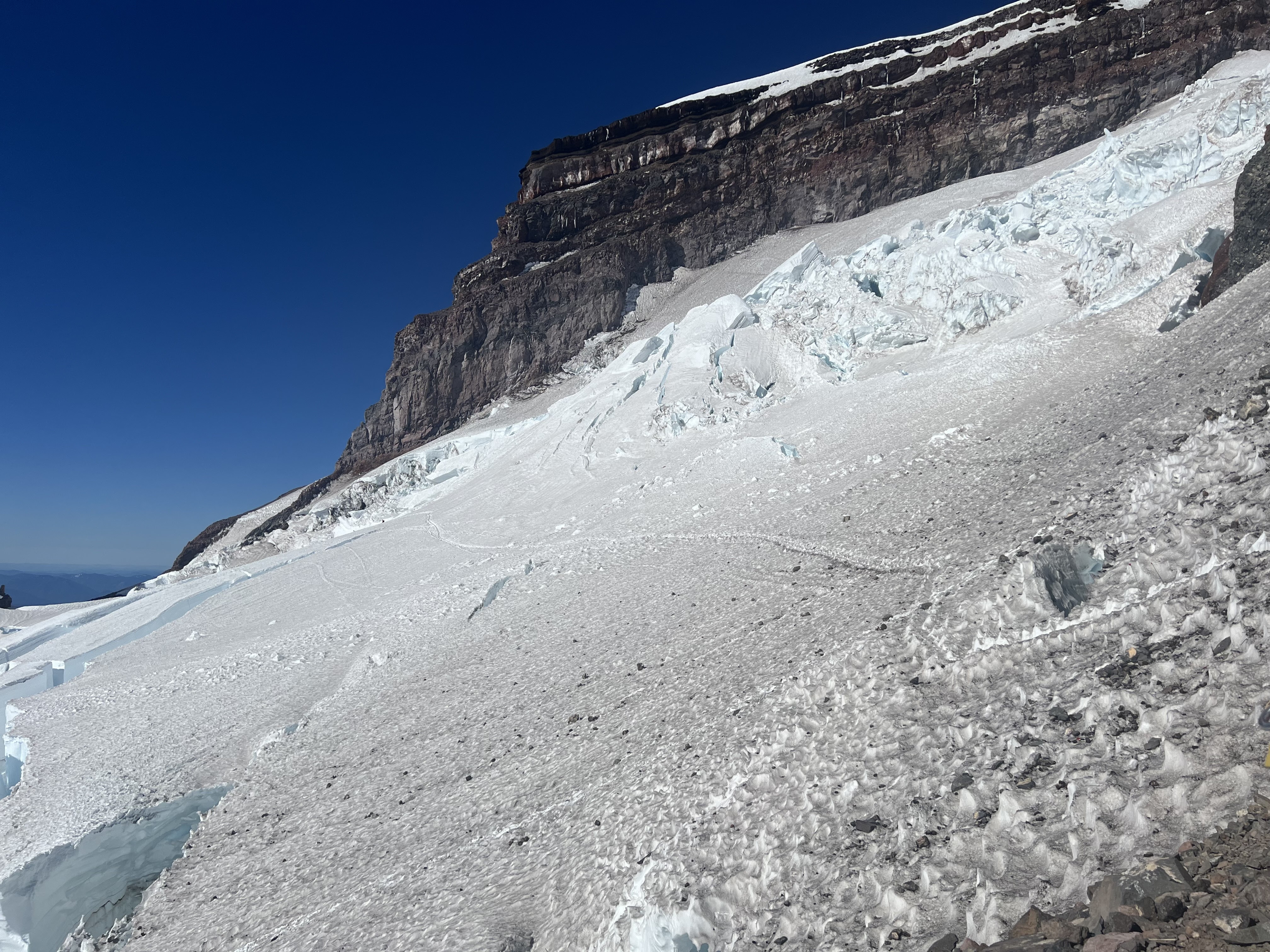
The Bowling Alley is a critical section of the Disappointment Cleaver route on Mount Rainier, known for its distinctive terrain and unique challenges. Nestled at around 12,600 feet, this area serves as a pivotal transition point in the climb, combining rocky outcrops with steep, glaciated slopes that require careful navigation. The name “Bowling Alley” comes from the bowling-ball-sized rocks that frequently tumble down its slope, a reminder of the rocky terrain and potential hazards that climbers must contend with.
As climbers approach the Bowling Alley, the atmosphere becomes charged with focus and caution. The steepness of the slope can be intimidating, and the risk of rockfall adds an element of urgency to each step. It’s a narrow corridor where teamwork becomes even more essential; climbers often stay in close formation, maintaining communication to ensure everyone is aware of their surroundings. The surrounding landscape, with its dramatic views of crevasses and the distant summit, serves as a stunning backdrop that both inspires and humbles those who pass through.
Navigating this section requires a combination of skill and awareness, as climbers must contend with loose rocks and varying snow conditions. The Bowling Alley is not just a physical challenge; it tests mental fortitude and the ability to adapt to shifting circumstances. Successfully traversing this area brings a sense of accomplishment, marking a significant step closer to the summit while reinforcing the camaraderie built within the rope teams.
Ladder crossing in the nightUp, Up, and Up
The Cleaver is a rugged, exposed ridge that juts out from the mountain, and it’s both technically challenging and mentally taxing. Climbers navigate a mix of loose scree, patches of ice, and exposed rock, making it essential to maintain balance and concentration. Stepping carefully, we follow a single-file path along the narrow ridge, the drop-offs on either side starkly reminding us of the importance of every movement. Each step demands a firm placement of boots and crampons, with roped team members watching each other closely to manage the risk of falls. At night, visibility is limited, and our headlamps cast only narrow beams, giving the route an eerie, tunnel-like feel. We inch forward, acutely aware of the exposure around us, with the mountain’s shadowed slopes falling away steeply. Crossing the Cleaver in the dead of night is an experience that blends caution, resilience, and respect for Rainier’s unforgiving terrain. It’s a passage that demands every bit of grit, focus, and trust in our team as we push toward the summit.
As we made our way past Disappointment Cleaver, the wind intensified, transforming the climb into a true battle against the elements. By the time we reached the area known as High Break, gusts had surged to over 70 mph, threatening to knock us off balance with every step. The howling wind seemed relentless, biting through layers of clothing and turning the icy ground beneath us into a nearly unyielding surface. Each climber clung tightly to their ice axe for stability, leaning into the wind’s force just to stay upright. Communication became nearly impossible; our voices were drowned out, forcing us to resort to shouting. The high winds magnified the mountain’s unpredictability, pressing us to reassess every step, each decision a test of endurance and resilience. In those moments, the summit felt like a distant goal, with every step forward requiring every ounce of focus and strength we could summon.
After passing the High Break point, the climb took a turn for the more challenging. I found myself struggling to keep pace, panting heavily as the altitude and relentless wind began to sap my energy. Each step felt laborious, and as the cold gusts whipped around me, I became acutely aware of my position as the last member of my rope team. The fear of holding everyone back weighed heavily on my mind, but I pushed through the fatigue, driven by a mix of determination and camaraderie.
There were moments when the wind seemed to grab hold of me, threatening to pull me off balance and backward. In those instances, I felt the tug of the rope as my teammates instinctively adjusted their positions, pulling me upward when I faltered. Their silent encouragement was palpable; it reminded me that we were in this together, and I wasn’t alone in this fight against the mountain’s elements. Each time they steadied me, it reignited a flicker of hope and resolve within me, reminding me of the teamwork that was crucial for our safety and success. Despite the exhaustion and uncertainty, their support kept me moving forward, step by painstaking step.
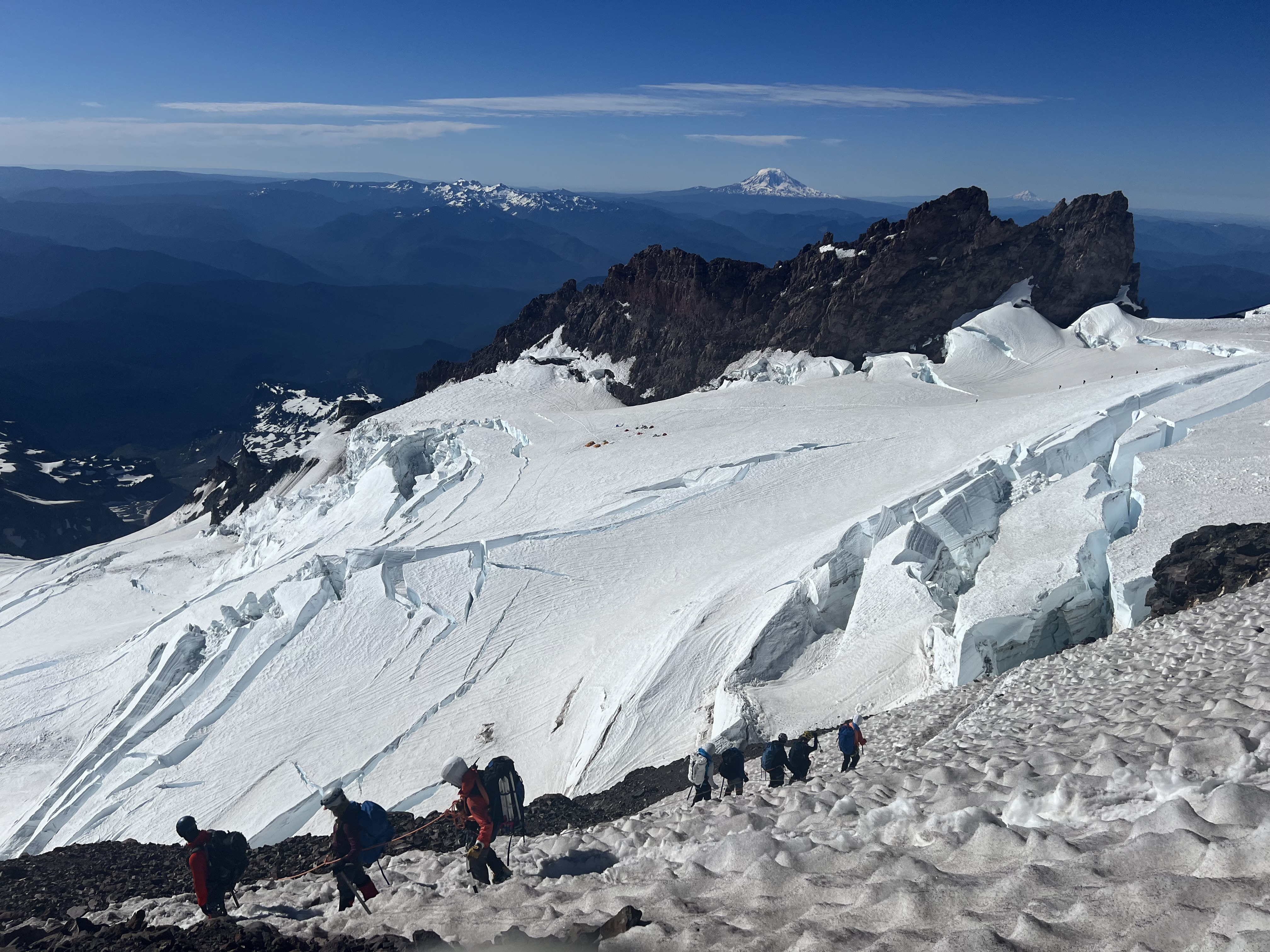
Climbers making their way to High Break, Little Tahoma seen in the backgroundLadder crossing at 13,000 feetThe three of us from the first rope team that made it to the summit
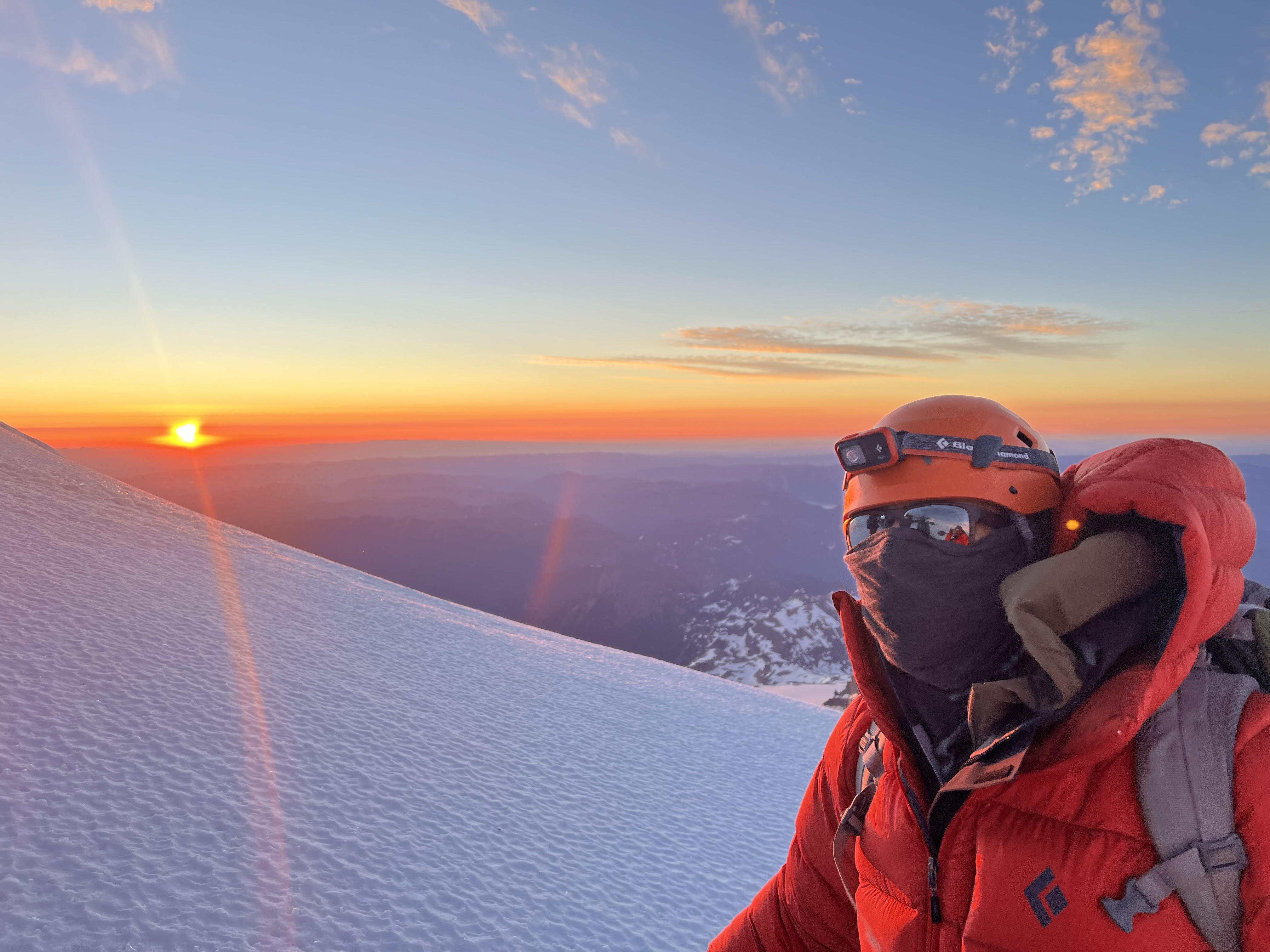
Finally reaching the summit of Mount Rainier was an indescribable moment, a moment of triumph and disbelief that washed over me as I stood atop the world at 14,411 feet. The climb had tested every ounce of my strength and determination, and as I looked around, the beauty of the landscape unfolded beneath me. The first light of dawn broke on the horizon, painting the sky in hues of otherworldly colors, casting a warm glow over the snow-covered peaks and valleys below. The sight felt surreal, as if we had earned a front-row seat to nature’s grandest spectacle. In that moment, the struggles and doubts melted away, replaced by an overwhelming sense of accomplishment and gratitude. I stood in awe, soaking in the vastness of the view, the crisp air filling my lungs as I took in the expanse of mountains and glaciers stretching as far as the eye could see. The challenges of the ascent faded into the background, and all that remained was the pure exhilaration of having reached the summit, sharing the experience with my teammates, and witnessing the dawn of a new day from the top of the mountain.
The way back
As we began our descent from the summit, the dawn light transformed the landscape, revealing the intricate path we had traversed during the night. What had felt like an endless, daunting ascent now unfolded before me in stark relief. The treacherous sections we had navigated — the exposed ridges of Disappointment Cleaver, the precarious glacier crossings, and the steep, rocky slopes of Cathedral Gap — were now fully visible, their dangers laid bare in the daylight.
Each step backward was accompanied by a mix of relief and trepidation as I realized just how precarious our journey had been. The sheer drop-offs and hidden crevasses that had been cloaked in darkness now loomed ominously, reminding me of the risks we had faced. I felt a renewed sense of respect for the mountain and the obstacles we had overcome. The climb that had once felt isolating was now a vivid tapestry of shared challenges, teamwork, and determination. As we retraced our steps, I couldn’t help but marvel at the strength of our rope team and the collective effort it had taken to reach this point. Each footfall became a reflection of our resilience and the deep bonds forged in the face of adversity, making the descent as meaningful as the ascent.
The bowling alley, with rocks strewing the trailTents seen off in the distance on Ingraham Flats, on what is considered a relatively safe groundRainier from Paradise Inn
Reflecting on my experience on Mount Rainier, I am profoundly grateful for the guides who led us through this incredible journey. Their expertise, patience, and unwavering support were the backbone of our expedition, turning what could have been a daunting challenge into a transformative experience. They shared not just their knowledge of the mountain, but also their passion for the climb, instilling in us a sense of respect for the unpredictable beauty of the wilderness. As I stood at the summit, looking out over the breathtaking expanse, I realized that the climb was not just about reaching the top but also about the lessons learned along the way: the importance of teamwork, the value of perseverance, and the thrill of embracing the unknown. Each moment on the mountain, from the struggles during the ascent to the exhilarating beauty of dawn breaking, etched itself into my memory, leaving me with a deep sense of accomplishment and a newfound appreciation for the power of nature. As I signed off this chapter of my climbing journey, I carried with me not only the summit but also the connections forged and the wisdom gained, eager to share these stories with others and inspire their own adventures.
Security is mostly a superstition. It does not exist in nature, nor do the children of men as a whole experience it. Avoiding danger is no safer in the long run than outright exposure. Life is either a daring adventure, or nothing.
This is me. As Charles Bukowski would put it - born like this, born into this. I don't like to talk about myself. I am afraid this is all you are getting now. I like to express myself through my poems, and stories and very soon another novel. I love you, my darling reader. So read on.
View all posts by Arjun Kramadhati